21 Aug The West, Reimagined: Altered States in the Acid West at UMOCA
As a lifelong fan of the Grateful Dead, I’m intrigued by alternate realities, rambling colorful musical prose and counterculture. Currently on view, Altered States in the Acid West at the Utah Museum of Contemporary Art (UMOCA) in downtown Salt Lake City checks all the boxes. And it only took the word acid to take me there. This free-your-mind exhibit features 23 artist portrayals of the American West that attempt to upend the mythology of the American cowboy and manifest destiny. By bringing to light the muted stories of America’s founding, the artists portray a more complete and painful version of history.
Through film, installation, sculpture, paintings, photographs, and textiles the exhibit draws from a subgenre of films from the late 60’s and 70’s called Acid Westerns. The term Acid Western was coined by film critic Pauline Kael to describe Alejandro Jodorowsky’s 1970 film El Tapo, also screening at UMOCA. A 1995 version of this theme is a strictly monochrome film titled Dead Man, directed by Jim Jarmusch, and starring the paradoxical actor Johnny Depp. Through surrealism, spiritual inquiry, and dark imagery, this genre reevaluates the romanticism of cowboy culture. From an early age we have been spoonfed a monochromatic vision of America’s birth. We gather around this narrative and it’s become our collective identity; a story we believe to be as unquestionably true and American as apple pie.
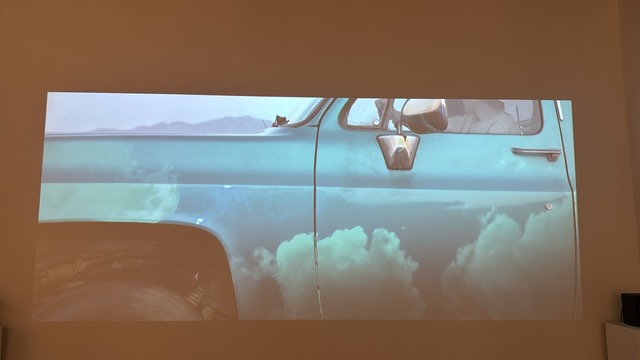
Entering, I hear the exhibit before I see it. There are 3 installations playing recorded sounds and the lights dimmed low. I sense the reverence. The exhibition opens with native Salt Lake artist Levi Jackson’s recurring video, Coming ‘Round the Mountain projected on a 20’ x 30” wall, a singular bench to sit and watch it play on and on. A vast desert landscape is the scene, as a vivid teal blue 90’s pickup truck is driven by a faceless driver. His body nods and moves calmly with the bumps on the dirt road. The camera “glides along” the truck, and the truck reflects that bright blue sky and puffy marshmallow clouds. It’s serene but the music is eerie and the tone suggests the scene could morph into a horror film. Creepy music swells to indicate all might not be what it seems. We will never know as the film goes on and on and I feel unsettled.
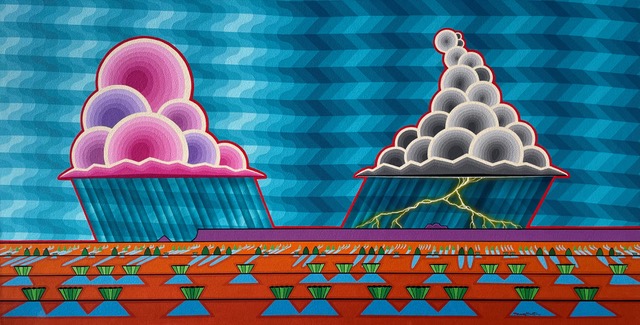
Next, I am grooving to a trippy acrylic on canvas by Diné (Navajo) artist Gilmore Scott. The Bears Ears Storm Dazzlers shows the outline of the twin buttes on the horizon in southeastern Utah called Bears Ears. Scott’s approach is graphic-like and uses Navajo rug weaving patterns to form the background. His colors are saturated and patterns are geometric. Dark thunder clouds and a lightning bolt rain down on the sandstone “ears” and bright blue hogans in the foreground surrender on the desert floor. This land is extreme and remote, yet Gil knows it intimately and can speak its language.
2016 brought Obama-era protections to over 100,000 archaeological sites in Bears Ears. Finally, it’s time for Gil to tell his story. “At least we’re at the table now,” he says. “Before we weren’t … and that was so frustrating, being on your own land where you grew up and not even being invited to the dinner. You’re sitting on the outside looking in, just wishing. But now our foot is in the door.”1
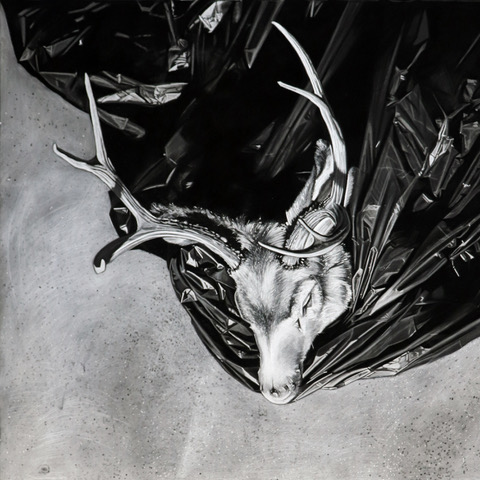
I am then haunted by Visceral 8, a large-scale charcoal and pastel rendering of a mule deer downed and dead by Shelby Shadwell. The deer lays on a hard surface wrapped in black plastic and made lifeless by the whim of the hunter. The antlers are sparkly and illuminated like a halo as if to suggest the deer might hold more value than a piece of meat. The giant “ziploc” bag acts as a reflection of our throwaway society. Shadwell’s online creative statement explains that his work has the effect of reverse sublimity, resetting the subconscious to see paradoxes. He states “Although I am part of the hunting community, I am trying not to be didactic or moralizing with the work in any way. Instead, my aim is to be visually poetic, drawing attention to conflicts in the human condition and asking viewers to question preconceived notions on all sides of these and adjacent issues.” 2
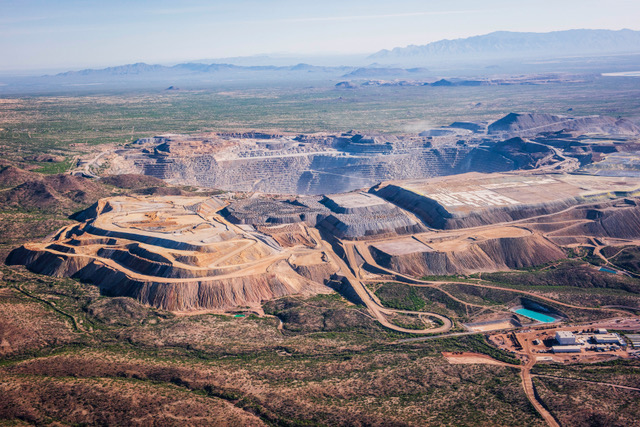
Settling the West must account for the extraction of its natural resources. Extraction is as common as the air we breathe and the scars it leaves are ghosts of the past. Salt Lake-based indigenous artist Russel Albert Daniels shines a light on these blemishes with his aluminum print Mother Wound: Extraction Asarco copper mines, San Xavier District border, Tohono O’dham Nation, Arizona. Russel illuminates the stories of the Native American peoples and their lands. His surreal image shows a network of rock layers and dirt roads that have been cut into a butte on a massive scale of 2.5 miles by 1.5 miles and 1,200 feet deep. The pool blue pond in the foreground is for the disposal of toxic waste water from the extraction process. It reads like a cute Tonka truck replica sandbox my son made at four years old. But there is nothing cute about this depiction. What is one man’s fortune is another man’s stolen land.
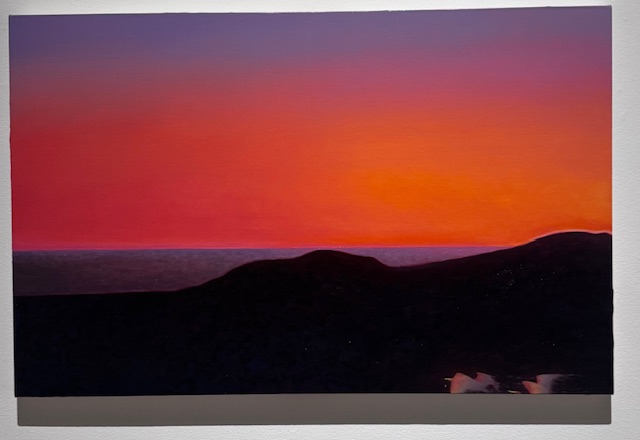
Flying Over Muir Woods, a painting by July Guzman, is an optimistic view with an orange and purple sunset and two egrets flying out to the vast open horizon. This piece is bright and hope laden. On July’s Instagram he writes: “I don’t even think the egrets know where they are going…the land always knows.”3
What strikes me about this UMOCA experience is it’s not a traveling exhibit. It’s conceived in Utah, at this very space, and it speaks to the complexities we are witnessing across the Southwest and predominately in my home state of Utah. Politicians are the new cowboys as they work to dismantle treaties and declassify national monuments with the tribal nations of Bears Ears and Grand Staircase Escalante. The Great Salt Lake, the largest saltwater lake in the western hemisphere, is drying off. Her waters have receded by 73% and she might be dead in 5 years. Her waters are a pawn manipulated by corporations and complicit legislators to divert more water to extract magnesium to operate our war machine. The alarm bells are ringing and no one answers.
This collection of mixed media reflects a different vision of America’s history and is one that shows the paradoxes of capitalism, growth and conquest. These voices form the antihero of the American story, the often painful realities of environmental damage and native culture erosion.These times and this exhibit has left me with deep sadness. The artists are the teachers and story tellers and they give the gift of an expanded consciousness. Certainly my mind is altered to new realities, but not in the kaleidoscope, trippy rainbow kind of way of a Grateful Dead show.
1. Zac Podmore, “Indian Art Market Features Artisans from 11 Western Tribes at the Natural History Museum of Utah,” Salt Lake Tribune, October 6, 2019.
2. Shelby Shadwell, Creative Statement, Visceral
3. July Guzman Instagram post, “My painting is in “Altered States in the Acid West” @utahmoca through June 6, 2026” @julyguzmn, February 1, 2026

Sorry, the comment form is closed at this time.